Showing posts sorted by relevance for query dumplings. Sort by date Show all posts

Saturday, September 3, 2011

Fruit Dumplings with Cottage Cheese and Butter

Ovocné Knedlíky
Strawberry Version


If you ask any adult Czech living abroad what childhood foods they miss the most, the Fruit Dumplings will be at the top of a list, no doubt. My mom was a master in making these and when I came to Canada every summer I dreamed about them. When she visited us for the first time it was this recipe that I just had to have. The version here is slightly modified because European ingredients are bit different but taste is the same.

There are several types of dough used for fruit dumplings. Some regions use dough made with potatoes and flour, others use cottage cheese and flour and some combine cottage cheese, boiled and riced potatoes and flour. I like to follow the KISS principle (Keep It Simple, Stupid) and just use plain flour.

 Ingredients for the Dough
1/4 cup milk (room temperature)
1/4 cup lukewarm water
1/2 tsp. vanilla extract
3 egg yolks or 2 eggs
1 1/2 tsp. instant yeast
1/4 cup sugar
Pinch of salt
2 cups all-purpose flour

Filling
1 pint strawberries, hulled, washed and halved.

 Process
In a bowl, mix together milk, water, vanilla extract and eggs.
In a food processor, pulse flour, salt, sugar and instant yeast to combine.
Slowly add liquid contents from bowl through the feed tube and mix till dough doesn’t stick to work bowl, about 45 seconds.
Since the flour moisture content varies you may have to adjust the ratio of liquid to flour by working in more flour if too wet or adding more water if the dough doesn’t form a ball.
Place the dough in clean, lightly buttered bowl, cover with plastic wrap and let it rise in warm and draft-free place until the dough has doubled in size, about 1 hour.

 Assembly
Punch the dough down and roll it out on floured board. You can roll the dough into 12-by-16 inch rectangle and cut it into 12 four-inch squares or roll it into a cylinder shape about 2” diameter, 18” long and cut into 12 disks about 1-1/2” wide and then flattened into pie shape that is 4” diameter. I did the later because I find it easier to make a ball with round disk instead of square.
Lay 2 strawberry halves into center of each disk, enclose the sides and roll it into a ball. Make sure that all the seams are tight and strawberries are well enclosed.
Place each dumpling on floured baking sheet, cover with towel and let them rise for 10 minutes.
In 4-quart pot, bring 3-quarts of lightly salted water to a bubbling boil. With a large slotted spoon, carefully place 4 or more dumplings (depending how wide your pot is) in the water. Partially cover the pot and once dumplings come to top, gently boil for 4 minutes. Turn dumplings over and cook additional 3 minutes.
Remove dumplings to large platter with a slotted spoon and immediately open each with 2 forks or prick them in several places with sharp needle to release the steam.
Repeat the process with remaining dumplings.
To serve, place 3 dumplings on preheated plate, top with cottage cheese, dribble melted butter on top and as an option, sprinkle sugar on top.
These dumplings are also popular when filled with pitted plums.


Sunday, January 16, 2011

Potato Dumplings - Chlupaté knedlíky (Czech)


Potato dumplings are somewhat similar to Gnocchi in that main ingredients are potato, flour and egg except these dumplings are made either with grated raw potatoes entirely or cooked and raw combined. Also, some use only flour as a binder while others use only farina (cream of wheat), then there are recipes that use both in all sorts of proportions. There are literally hundreds of recipes in Czech Republic for potato dumplings. Every region, city, village and family has their own. Actually, I think that same is true about any peasant dish in any culture. Since I’ve been making gnocchi for a while now and am comfortable with potato based dough I came up with my own version.
1 raw Russet potato, peeled and grated fine
1 Russet potato, “baked” in microwave (see Gnocchi recipe)
1 egg, beaten
1/3 c. farina (cream of wheat)
1/3 c. flour
1 tsp. baking powder
Salt and white pepper to taste
Peel and rice cooked potato in food mill. You can grate cooked potato using box grater or, to be more rustic put it in heavy plastic bag and smash it with heavy frying pan J.
Mix raw and cooked potatoes together with the beaten egg. Sift together farina, flour, salt, pepper and baking powder and fold in potato mixture. The dough should be stiff enough to form a small ball.
Bring salted water in a large pot to roiling boil. With soup spoon form balls little smaller then golf ball. When all dumplings are ready drop them gently into boiling water. Dumplings should loosely cover the bottom in one layer. When water comes back to boil lower the temperature to gentle boil. Release dumplings that stuck to bottom of a pot and boil for 15 minutes.
When done, remove with slotted spoon to preheated frying pan with some bacon fat or lard and coat lightly.
Sprinkle with dry toasted bread crumbs and serve.
Potato dumplings are traditionally served with sauerkraut and smoked meat.

Release dumplings that stuck to bottom
Once on surface boil for 15 minutes.
Drain and fry in bacon fat.

Saturday, January 1, 2011

Bread Dumplings


Dumplings served with pork roast and sauerkraut.
To Czechs and Slovaks, bread dumpling is what pasta is to Italians and rice to whole Asia. It is almost a daily staple served with any food that has a sauce. Basically, it is just yeast bread with stale bread cubes mixed in. The “bread” in the name refers to these bread cubes. There are two ways to make them light and spongy: yeast and double acting baking powder. Since I have never made them with baking powder I will stick to the more traditional yeast dough.
I should mention that you will need fairly large pot to boil them. I use my deep stainless steel 9”x14” oval roasting pan, just a perfect size to boil 2 dumplings.
You can use regular enameled steel roasting pan, of course. Also, I would recommend to boil only one dumpling at the time since they have to be cut in half as soon as they are removed from the water and pierced with long bamboo skewer to release steam.

3 ½ cups flour - all purpose
sugar (pinch)
1 tsp. salt
1 Tbs. Instant yeast
1-1/2 cup day old bread, cut into 1/2” cubes
1 cup scalded milk (microwave for 1-1/2 min.)
2 beaten eggs
1/2 t. baking powder

1. Microwave milk with pinch of sugar and let cool.
2. Beat eggs and add to cool milk.
3. Mix flour with milk & egg mixture for ½ minute then add yeast.
4. Knead in mixer till sides of bowl are clean.
5. Place on work table and add bread cubes. Knead by hand till smooth and elastic.
6. Divide into two equal parts, roll into an oblong shape and place on large tea towel sprinkled with flour to prevent sticking. Cover with another towel and let raise till double in volume.
7. Lift the dumpling carefully with the bottom tea towel and gently lower into a large pot of boiling salted water. Be careful not to collapse the raised dough.
8. Boil for 13 minutes on one side then turn and boil for additional 10 minutes.
9. Remove from boiling water and immediately cut in half and pierce in several places with skewer to release steam. Place on a baking sheet or plate with cut side down and cover with towel till ready to use. To serve, cut slices about 1/2” thick. The halves of dumplings freeze very well. To use frozen dumplings, just let them thaw, slice and steam for few minutes.
I have roasting rack with wire loop at each end to lower and remove the dumplings. The rack came with the pan so it is a perfect fit.

Thursday, January 20, 2011

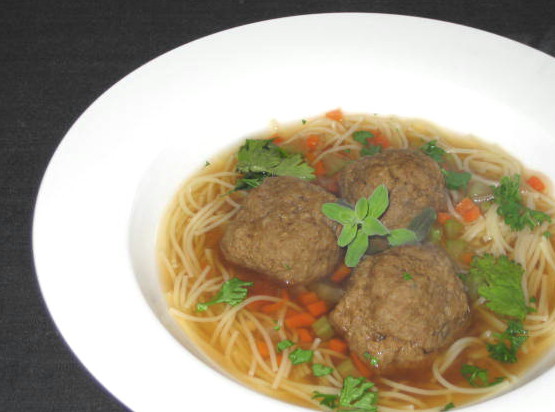
Liver Dumpling Soup

Yes, another dumpling recipe. This comfort soup is one of our favorite soups to go to when it is miserable outside. It is too bad that many people would never give a second look at anything that has a liver in it. I use very fresh calf or baby beef liver for these dumplings and you can’t detect any liver taste or smell at all. As is the case with most soups you can easily control how substantial the soup is just by modifying ratio of stock to solids, in this case number and size of dumplings and amount of egg noodles and vegetables.

For dumplings:
Baby beef or Calf liver, 1 slice
1 egg, beaten
1/4 cup milk
1/2 tsp. white pepper
1 tsp. salt
Garlic, 2 cloves, chopped
1/2 tsp. marjoram
1 tsp. baking powder
1/2 cup bread crumbs mixed with 1 Tbs. flour/
Breadcrumbs, as required
Soup:
8 cups beef or chicken stock, carton or can is fine
1 large carrot
1/2 medium onion
1 stalk celery, all finely chopped
Marjoram
Garlic, finely chopped
Fine egg noodles
Parsley


Remove all traces of membrane on liver, roughly chop and then run through grinder or food processor to make a coarse paste. Remove to mixing bowl and add beaten egg, milk, salt, pepper, baking powder and marjoram and mix till well combined. You will now have fairly thin batter. Add 1/2 cup of bread crumbs with flour, mix well and let it rest for 10 minutes or so for bread crumbs to absorb moisture from liver mixture. Remix and add adjust with more bread crumbs or milk until you can form a ball. Form walnut size balls and set aside.
To make soup, pour stock  into a soup pot, drop in all chopped vegetables and bring to boil. Cook for 5 minutes, lower heat to simmer and drop in all liver dumplings, being careful not to splash hot stock. Gently lift dumplings with spatula from bottom so they don’t stick. When all of them are floating on top, cover and simmer for 5 minutes. Add fine noodles and stir to prevent noodles from sticking together. Cook additional 5 minutes, add marjoram, taste and  adjust seasoning. Serve with chopped parsley sprinkled on top.

Thursday, January 19, 2012

Pork Pot Stickers


The pot stickers are another dim-sum favorite snack and uses basically same ground pork mixture as Shu-Mei steamed dumplings and steamed Pearl Balls. It is very tedious to make so typical Chinese family do not make them at home, but I have no choice, there are no dim-sum restaurants in our town. I don’t mind even though as a full meal it takes me about half an hour to make them, another 15 minutes to cook them and then just few minutes to eat them all. C’est la vie.

Ingredients

3/4 pound pork butt or equivalent ground pork
1/2 Tbs. fresh ginger, minced
1/2 cup finely chopped Napa or Savoy cabbage leaves
2 tsp. chopped garlic
1 tablespoons water chestnut, finely chopped
3 green onions, minced
2 shitake mushrooms, soaked and chopped fine
1 Tbs. Sake or rice wine
1 tsp. soy sauce
1 tsp. sesame oil
1/2 teaspoon salt

1/2 tsp. white pepper
1 tsp. sugar
1 Tbs. cornstarch
Won-ton wrappers
Bowl with water for sealing the dumplings

Directions
Mix all the ingredients except the wrappers, cover and refrigerate for 2 hours to blend the flavours.

1.     Spoon 1 heaping teaspoon of the filling onto a dumpling wrapper. Don’t be tempted to overfill! Dip your finger into the water and “paint” all around the edges of the dumpling skin.
2.     In the middle, pinch the top and bottom together, tightly.
3.     Starting just left of the middle, use your left hand to bring the TOP portion of wrapper to pleat towards the middle. Pinch to secure that pleat. Move down just a bit, and do the pleating again. Repeat once more. You will have 3 pleats on each side, all pleats pointing towards the middle.
4.     Now, it’s time to do the right side. Do the same using only the top portion of wrapper. Pleat towards the middle, or to the left. Repeat 2 more times.
5.     Finish by pinching the pleat all around one more time with your thumb and lower portion of your finger. Remember, any unsealed section will cause the potsticker to leak filling!
 
To cook the potstickers, pour about 2 tablespoons of oil into a non-stick frying pan over medium heat. When hot but not smoking, carefully place the dumplings in frying pan, flat side down, not touching each other. Do not crowd too much or they will not brown. Fry the dumplings in batches for 4 to 5 minutes, until the bottoms are nicely browned.
Add 1/4 cup (65 ml) of water and immediately cover to start the steaming process. Steam for 3 to 4 minutes. Remove the lid and let the rest of the water boil off and re-crisp the bottoms, about 1 minute. Cut open one of the dumplings and make sure the inside meat is cooked. Before starting your next batch, wipe the frying pan clean before adding more cooking oil. Adjust amount of water and steam time for the next batch as needed.

Check this website for clear illustration on folding the potstickers

Ready for cooking. Little bit too crowded for comfort but we were hungry!


Monday, February 28, 2011

Tenderloin with Sour Cream Sauce and Dumplings

Svíčková na Smetanĕ s Knedlíkem
Just like Pork Roast, Sauerkraut and Dumplings this is a typical Sunday lunch or supper but since tenderloin is so much more expensive then pork roast it is a very special meal. Also the fact that it takes a lot more work to prepare makes it even more special. There is a lot of chopping involved but food processor or mini chopper makes it a breeze. Same goes for finishing the sauce with immersion blender. Since both cuts of beef are quite dry the meat is larded.  
Ingredients:
2 lb beef tenderloin or eye of round (not as tender)
1 large carrot, peeled and very finely chopped
1 onion, peeled and very finely chopped
Celeriac, about 1/4, peeled and very finely chopped
1 parsnip, peeled and very finely chopped
2 slices of 3/8” thick bacon fat cut into 3/8” strips
1-1/2 cups beef or chicken stock
Freshly ground:
6 Allspice
1/2 tsp. peppercorns
6 cloves
1 bay leaf

1 cup sour cream
2 Tbs. flour
Directions:
Lard the meat and tie with butcher twine every 3”.
Season with ground spices on all sides and place into a heavy, sealable bag. Put all chopped vegetables in the bag together with meat and close the bag while removing as much air as possible. Distribute the vegetables until they cover all sides of meat. Place in refrigerator and marinate overnight.
Next day, remove meat and vegetables from bag, scrape all vegetables from meat, set aside and reserve vegetables.

Beef is ready for frying pan. Dumplings are raising in the background.
Preheat oven to 350 °F.
Heat a frying pan on high, add 1 Tbs. of oil and brown meat on all sides, about 3 minutes on each side. Move to a roasting pan.
In the same frying pan cook reserved vegetables till lightly brown, about 10 minutes. Remove to roasting pan and place most vegetables under the meat.
Pour in the stock, cover pan and bring to boil. When stock starts to boil turn off the heat and move the pan on middle rack in oven and roast (braise), covered, for 1-1/2 hours or till internal temperature reaches 140 °F.
Meanwhile, steam the dumplings that were made ahead.
Remove meat to plate, cover with aluminum foil and let rest.
Scrape all fond (brown coating on side of roasting pan) into vegetables and pour into high sided sauce pan. Using immersion blender, liquefy the sauce till smooth.
Place sauce pan on heat and bring to simmer. Meanwhile, in a bowl, whisk sour cream with flour till smooth and well combined. Pour in a cup or so of hot vegetable sauce and whisk till smooth (to temper the sauce). Remove all the sour cream mixture back into sauce pan, mix and reheat. Do not bring to hard boil, just a very gentle simmer. Pour in accumulated juices from meat into sauce pan and mix.
Ladle in some sauce on preheated plate, slice the meat and place on sauce together with dumpling slices. Serve with Pilsner Urquell.

Monday, January 10, 2011

Seared Duck Breast, Red Cabbage & Dumplings

This is West Europe/East Europe fusion food. If there is such a thing, of course. I do not think that seared duck breast was on East European grandparent’s menu and dumplings on West Europe’s menu but to me it was so logical to combine the two. And it does work! The breasts were done by a cold pan method that is so effective. I don’t know what culinary genius was first to use this fool proof method but I know that this is the best way to cook a duck breast. The dumplings were already done and red cabbage was just heated so it was relatively fast and pain free meal.
Now it goes in 400 °F oven for another 5 minutes.
Oh, so good! And of course, Pilsner Urquell, the true and only original pilsner is perfect with this meal!

Tuesday, September 6, 2011

Chicken and Polenta Soup Balls

As I mentioned on my “Baked Pimento Pepper Halves” post, I made these dumplings using minced chicken and polenta instead of usual matzo meal or bread crumbs. It was an experiment that turned out better than I had expected. It started quite innocently with polenta experiment. I had an e-mail thread going with my favorite nephew Seb about cooking polenta. I wanted to know if it can be cooked in microwave. I took 1/2 cup of chicken stock and nuked it for 45 seconds on 100% power, then mixed in 1/4 cup fine ground corn and cooked another 45 seconds on 75% power, uncovered. And, what do you know; it had a decent texture and tasted cooked, it was actually pretty good even though it was on a dry side. I left it on my kitchen island and started to prepare new chicken-on-skewers recipe from Cooks Illustrated where chicken breast is kept moist by coating it with bacon paste made in mini-chopper. I made the paste with 2 cloves of garlic and then I changed my mind about the skewers, there just wasn’t enough meat for two people. Eureka! Chicken dumplings for a soup!
I cut up the breast into small pieces and then minced it in mini chopper together with 1 egg, 1/2 tsp. of salt, 2 Tbs. of chopped garlic chives, 1/2 tsp. marjoram, 1/2 tsp. baking powder and 1/2 tsp. of white pepper. Then I mixed in the polenta, formed it into 1-1/2” balls and slowly simmered in salted water for 15 minutes. They came out nice and fluffy (baking powder J).
These are now my favorite dumplings for a chicken noodle soup.

Monday, January 17, 2011

Ham, Sauerkraut and Potato Dumplings

This is a true comfort food and once you have made dumplings it is a cinch to put together. Just cook ham any way you prefer, boil, bake or braise, cook sauerkraut and serve with potato dumplings.
I bought shank end of bone-in smoked ham that came in at 4.5kg or 10lb, put it in large cast iron Dutch oven and poured in water about half way up the meat. It took 3-1/2 hours at 350°F to braise, covered, for a fall-off-the-bone done. Nice no-work method. Not only did I end up with great, tender ham, but now I have 2-1/2 quarts of fantastic ham stock for pea soup as well. Nice bonus. One thing I will change next time is that I will not cut the skin in diamond pattern, I will leave the skin whole. Since I like the nice chewy texture of the pork skin but not all that fat underneath, it will make the job of removing extra fat much easier.
Even though this meal looks fairly light, is quite filling. It will become a Winter standard.

Monday, September 19, 2011

Hungarian Gulyás (Goulash)


Goulash is a stew or soup made with meat, vegetables and potatoes. In Hungary, it is lot closer to soup then a stew and it doesn’t contain tomatoes. There are many versions in former states of Austrian Hungarian Empire. In Czech Republic and Slovakia the liquid base is chopped tomatoes and it is served with either bread or Bread Dumplings, in Austria it is served with rye bread and in Northern Italy with spaetzle or gnocchi. However, one ingredient that is constant right across whole former Empire is paprika, and lots of it. Also, in Czech version, there are as many onions as there is meat, by weight, and green and/or red peppers are always included and potatoes are seldom cooked in goulash itself but rather on side if used as side dish.
As is the case with every national dish there are many regional varieties. Szeged goulash is made with pork, some potatoes are replaced with sauerkraut and sour cream is added at the end of cooking. Znojemský (Moravian) Goulash is made with beef, onions, peppers and chopped pickles. In short, there are as many varieties as there are regions. In this post I will deal with a basic beef goulash using tomatoes and with potatoes on the side.

Ingredients
1 Lb. stewing beef
1 Lb. onions, roughly chopped
3 cloves garlic, crushed
2 Tbs. Hungarian paprika
1 tsp. caraway seeds
2 green and 2 red peppers, roughly chopped
4 tomatoes, skinned, seeded and roughly chopped
Tbs. lard or vegetable oil
2 Tbs. flour
2 bay leaves
1 tsp. dried marjoram
Salt and pepper to taste
Cayenne pepper (optional)

 Place flour and beef inside plastic bag, close it and shake the beef until all sides are evenly coated with flour. Shake off all excess flour and set aside.
Heat up lard or oil in heavy pan or Dutch oven on high heat. Place the beef cubes in lard, leaving space in between, and brown on all sides. Remove beef to bowl and set aside. The beef will release some juice.
Pour off the lard leaving just a thin coat on the bottom. Lower the heat to medium, drop in the onions and garlic and cook till light golden brown.
Off the heat sprinkle the paprika and caraway seeds on top and then mix until onions are evenly coated.
Put back on medium heat, add peppers and tomatoes with its juices, stir and bring to simmer.
Put back the beef with collected juice, bay leaf and black pepper. Bring back to simmer on medium high, lower the heat to low and simmer, stirring and scraping the bottom every 15 minutes or so.
Braise for 3 hours making sure that there is enough liquid. If too dry add some liquid such as beer, wine or stock.
Other option is to cook the goulash in the 350 °F oven. 10 minutes before serving add marjoram and adjust seasoning (salt, cayenne pepper).
Serve in preheated shallow bowl with potatoes, pasta, bread dumplings or just slices of rye bread.
As is the case with many stews, this goulash taste better when reheated next day and when served with a different side you end up with a new meal.

Beef is already coated in flour.

Meat is browned, onions and garlic are cooked and paprika and caraway seeds are mixed in.

Peppers, tomatoes with its juice are added and brought back to simmer.

Beef is returned to pot with bay leaves, pot is covered and slowly braised for 3 hours.


Saturday, December 25, 2010

Roasted Duck Legs with Red Cabbage and Dumplings

(Traditional Christmas Dinner)
As I noted in my previous blog this is perfect Christmas dinner for just two of us.
Since I had quite a few pieces of rendered skin from last night when I cut up the duck I used it as a bed form my legs so that the meat will not dry up. Both sides of legs were sprinkled with a bit of salt even though they were brined and about a tablespoon of crushed caraway seeds. Incredibly, there is no garlic. I covered the legs with parchment paper and then aluminum foil. The paper is there because the salt on duck would burn holes in aluminum if it comes into direct contact. I use it every time if aluminum foil would touch piece of salty food.
Duck is roasted similar way as pork roast but it takes only about 2-1/2  to 3 hours for meat to be off-the-bone tender and skin nicely golden and crisp.
First half hour in 375°F, then 350°F for 2 hours and back to 375°F for 15 - 30 minutes or till skin is golden. It is served with sautéed red cabbage (from jar J) and steamed dumplings.
  

Ready to be covered and roasted.
After 2 hours uncover and roast until golden brown.


Tuesday, November 30, 2010

Xiao Long Bao – Shanghai Steamed Soup Dumplings

Making these Dim Sum dumplings will be one of my winter projects. Is it ever labor intensive and complex! No need to go into detail here, just visit Steamy Kitchen blog, read the very well written article and salivate.

Thursday, December 23, 2010

Pork Roast, Wine Sauerkraut and Dumplings (Czech)

This is a King of Czech Sunday dinners. Without doubt, only competition is Svíčková, loosely translated as “Roasted beef tenderloin with root vegetable and sour cream sauce” which is quite complex to prepare. Pork roast is so simple: just rub a pork butt, preferably with skin on, with mixture of kosher salt, crushed garlic (I like a lot of it) and caraway seeds, place in roasting pan, pour about ½ cup of water in a pan, cover and place into 375°F preheated oven for ½ hour then lower temperature to 325°F and roast, still covered, for 2 hours turning and basting once halfway through. Increase temp to 375°F, remove cover and roast another ½ hour or till meat is golden and skin is crisp. It is traditionally served with hot sauerkraut and bread dumplings.
Note: Notice the perfectly roasted and crunchy skin at top of plate! Is it ever good!
The King of Czech Sunday dinners is ready for plating with no garnish or just bare minimum.

Thursday, December 9, 2010

Paprika Chicken (Paprikás Csirke)


Beside Hungarian Beef Goulash this must be best known Hungarian meal. It is just too bad that I can’t have it more often because it is so obscenely rich. And because of that, is it ever tasty! Original recipe calls for whole chicken cut up. I use chicken thighs that I consider the very best part of the bird, there is so much flavor and it can be cooked in so many ways from soup through BBQ to slow stewing. Paprika Chicken is just that, a stew. It can be served with noodles, rice or potatoes but back in Czech Republic we always had bread dumplings. They really soak in that wonderful rich sauce!
Lets get down to business.

To serve 2 with leftovers J.

4 large chicken thighs, chopped in half (8 pieces)
3 T. lard or veggie oil
1 large onion, finely chopped
4 cloves of garlic (or more if you are like me)
2 or 3 T. sweet Hungarian paprika
1T. hot Hungarian paprika
1-1/2 cup chicken stock (canned is fine, I use it)
1-1/2 cup sour cream (stay away from light stuff, light sour cream is an oxymoron)
2 T. flour

Preheat oven to 300 °F.
Pat the chicken pieces dry with paper towels and salt and pepper generously (I always brine my chicken so I skip the salting).

In a Dutch oven heat the lard or oil until light haze forms over it. Add the chicken pieces skin side down and shallow fry them till golden brown, about 3 minutes.

Turn them over and cook for another 3 minutes.

Remove to a bowl and pour off all the fat, leaving only a thin film.

Lower the burner to medium heat and add onions and garlic and sauté until lightly colored.

Remove from heat and mix in sweet and hot paprika until the onions are well coated.

Return to heat and add chicken stock and bring to boil. Return pieces to pot, cover and place on middle shelf in oven. After one hour the chicken should be fall-off-the-bone tender. Remove from oven.

Remove the chicken to the same bowl as before and skim all fat from surface of the pot. (I use hot spoon and then strips of paper towels to really remove all the fat. I mean, we’ll be adding quite a bit of fresh fat in form of sour cream in next step.)
In a mixing bowl with wire whisk mix the sour cream and flour until smooth and then add about a cup of hot sauce into sour cream to temper it.

Stir the mixture back into pot, return the chicken with all accumulated juices to the pot and bring it slowly to simmer. Do not boil or the sauce will separate! After 3 minutes remove from heat and serve.
Bread dumplings are basically bread dough loaves that are boiled. They are very soft and soak up sauces like a sponge. It is almost daily staple at Czech table just like pasta is at Italian table.